

The contested Ha Mathata land with maize crop. Photo: Retselisitsoe Khabo
Billy Ntaote
A missing government file has become the centre of a standoff between the Lesotho government and residents of a small village who say they were never compensated when their land was taken.
The Ministry of Local Government declared the village of Ha Mathata a Special Development Area in 2000. This legal step should only have been possible if the government had paid compensation to the villagers for their property.
The MNN Centre for Investigative Journalism (MNN) can confirm that a file for the neighbouring village, Ha Nyenye, contains a payment record showing who was compensated and how much they received. But there’s no such record in the Ha Mathata file, which MNN has also seen.
Government insists that residents were paid and accuses them of trying to claim compensation twice. Residents deny this. With the payment record missing, a document that could help settle the dispute has vanished from the very government file meant to record what happened.
MNN has also seen a confidential 2022 report by the Lesotho Housing and Land Development Corporation (LHLDC) which based on meetings with Maputsoe Urban Council officials and community elders, concluded that the original Ha Mathata landowners had been compensated. It refers to lists of Ha Mathata residents who had been paid. But the underlying payment records showing who received the money, how much, and when are missing.
Chief Lands Officer Masebele Mponye told MNN that an SDA can only be declared when all compensation has been completed. She said the land in Ha Mathata was acquired as a form of land banking, a strategy to obtain land at current prices for future developments.
The land banking that Mponye describes is clearly defined in section 44 of the Land Act 1979, but is referred to as a selected development area.
Section 44 allows the Minister to declare land a Selected Development Area for public interest development, extinguishing, existing titles subject to substitute rights provided under this part.
Despite the missing payment record, Mponye insists that payments had to have been made to Ha Mathatha. While Mponye suspects that residents are exploiting the opportunity for a second payday posed by the missing records, a group of Ha Mathatha residents rejects this allegation, saying their claims stem from their own family histories of payments not made, not knowledge of a paperwork gap.
How the dispute resurfaced
Claims of non-compensation resurfaced when LHLDC began trying to acquire agricultural land belonging to the St. Monica’s communities next to Ha Mathata. The corporation’s Managing Director, Malesekele Matekane, told MNN that St Monicas had never been formally acquired and compensated.
Records obtained by MNN show that the ministry of local government transferred land in Maputsoe, including areas of Ha Mathata, Ha Nyenye and St Monicas, to Lesotho Housing in 2018. In a 22 March 2018 letter then Principal Secretary Tseliso Mokoko, now a High Court judge, wrote that the ministry had decided to transfer land at the following places in Maputsoe to the LHLDC for housing land servicing. The letter lists three areas, including about 50 hectares stretching from the Khomokhoana project along Sir Seretse Khama Road towards Hlotse.
Mokoko wrote that: “Part of the fields have already been acquired,” but he instructed LHLDC to “engage with owners of uncompensated fields to sort out compensation” for the remaining land earmarked for the expansion of Maputsoe town.
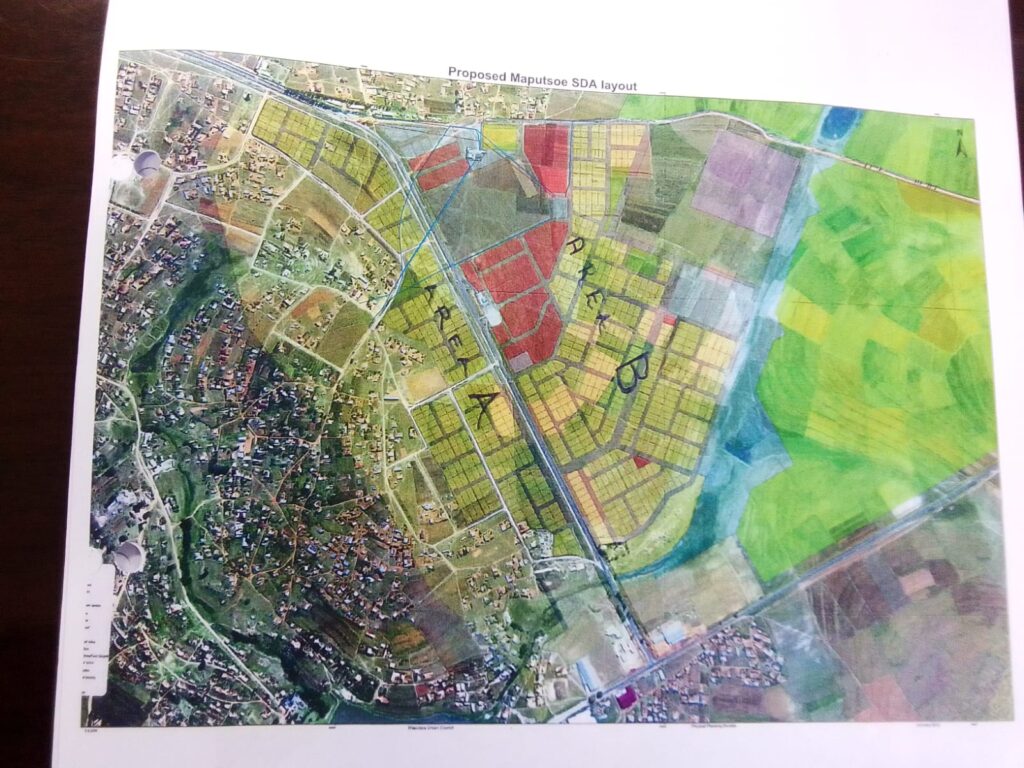
A layout of the Maputsoe SDA showing Ha Mathata land marked Area B captured from LHLDC files
Mponye said Mokoko’s reference to fields that had “already been acquired” referred to Ha Mathata, while the uncompensated fields were those at St Monicas.
Matekane, said the Ha Mathata claims resurfaced when Lesotho Housing began implementing Mokoko’s 2018 instructions.
Residents told MNN that their campaign for compensation gained momentum after they observed court victories by other communities challenging government land acquisitions. “We came together after seeing other people successfully winning cases against the government to regain control over their land,” said Joang Molapo, a former minister who is also a chief and a resident of Ha Mathatha.
Joang Molapo said residents were considering a class-action lawsuit, arguing that the original acquisition had not met the legal requirements. Their main demand, he said, was compensation or ownership of their land.
“If the government is still interested in the land declared a Special Development Area, then we can start afresh. But if not, the land should be handed back to us so that we can use it for our own benefit,” he added.
But accounts among residents themselves are not consistent.
While most of the residents who would have received any of the compensation have died, Keketso Molapo, who is also Joang Molapo’s uncle, says he remembers being paid, but not enough.
“There was an announcement that the government would take the land, but that compensation would be paid. However, I do not understand how things were carried out when it comes to our compensation as field owners,” he said.
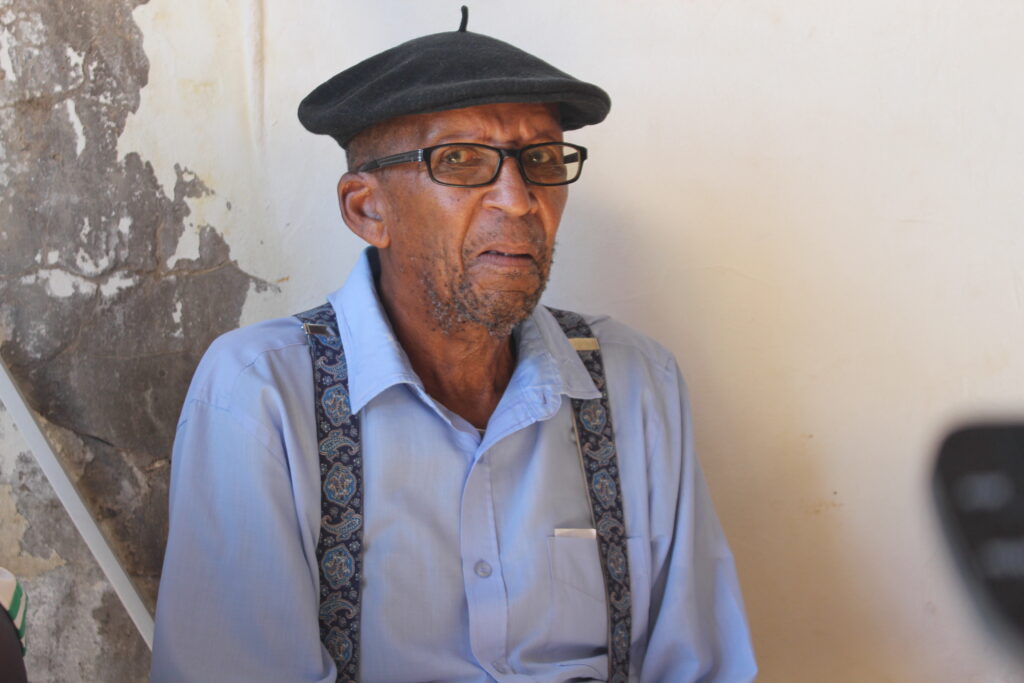
Ha Mathata resident Keketso Molapo. Photo: Billy Ntaote
At this point in the meeting between MNN and affected residents, some residents said that the interview should stop. Following this, one resident who spoke to MNN but asked to remain anonymous said: “I realise that many of the things that happened concerning the fields were handled by our parents. The people who dealt directly with the government are no longer alive.”
Another member of the group said the affected families themselves do not all share the same understanding of what transpired.
“We do not have the same story,” the resident said.
“There are some people who know that compensation was paid, while there are others like me who grew up knowing that there was never any compensation paid for our land,” the resident said.
Khosi Chaola, who inherited rights to his family’s fields, told MNN that heirs had never seen evidence that their parents were compensated.
“We are not the original field owners. The land belonged to our parents,” Chaola said.
For the residents of Ha Mathata, the central question remains unanswered.
“If the government says our parents were compensated,” Molapo said, “then it should produce the documents that prove who was paid, how much they were paid, and when they were paid.”
But officials say residents seek double compensation
Lesotho Housing and the Ministry of Local Government maintain that the Ha Mathata residents’ claims emerged only after plans to develop the area gathered momentum.
According to Lesotho Housing Managing Director, when the corporation received the land in 2018, officials were informed that some portions of land had already been compensated while others, particularly in the St Monica’s area, still required compensation.
“We identified those who had already been compensated and those who had not,” Matekane said.
“We worked with information from the Maputsoe Urban Council and conducted valuations for those whose land had not previously been compensated.”
Matekane questioned why claims of non-payment only surfaced years after Lesotho Housing had taken control of the land.
“The land was transferred to us in 2018, but the first legal challenge only came in 2023,” she said. “Why now?”
She argues that some of the people claiming compensation are descendants of original field owners who may not know whether their parents or grandparents received payment decades ago.
Advocate Thabo Nteso, who represents the Ha Mathata residents, told MNN he has filed an appeal against the decision of the magistrates made in 2024.
“A judge is yet to be allocated to our case and set down to be done on what would happen next in terms of the rules of the court.”

Lesotho Housing and Land Development Corporation’s Managing Director, Malesekele Matekane. Photo Credit LHLDC.
Nteso said the Magistrate should have heard oral evidence under the rules governing land disputes and that the matter could be returned to the lower court for evidence to be heard.
Matekane said the corporation had not been formally served with any appeal documents and therefore could not regard the matter as an active appeal.
“We have heard that they are appealing the judgment, but we have not received any application for condonation or any court papers confirming that an appeal has been filed,” Matekane said.
“You will find that some of the claimants are grandchildren of people who were compensated,” she said. “Others acknowledge that compensation was paid but argue that the amount was too little. These claims are opportunistic.”
Chief Lands Officer Masebele Mponye shares a similar view.
She said investigations conducted by the government and the Maputsoe Urban Council identified individuals who had received compensation when the land was acquired.
“The investigations revealed who had been compensated,” Mponye said.
“What is missing is the documentation showing how the payments were made.”
MNN also spoke to a former Maputsoe Urban Council councillor who served after the compensation exercise and who agreed to speak only on condition of anonymity for fear of reprisals.
The former councillor said he knows, from his time in local government and from records he encountered, that compensation for the Ha Mathata fields was paid in the 1990s, while compensation remained outstanding only for landowners in areas such as Ha Motetepa, Ha Poulo and St Monicas.
“Deep down they know the land is no longer theirs. Their parents were compensated,” he said.
“They are only demanding compensation now because they have seen how much compensation is being paid elsewhere,” he said.
Missing records fuel suspicion
Yet the absence of payment records remains the central unresolved issue.
Mponye acknowledged that while the government possesses information identifying people believed to have been compensated, records detailing how the payments were made cannot be found.
According to Mponye, the claims of non-payment prompted the Ministry of Local Government, working with the Maputsoe Urban Council, to institute an inquiry aimed at establishing who had been compensated and who had not.
She said the inquiry involved tracing and interviewing surviving former council employees who were involved in administering compensation payments to landowners when the acquisition was carried out in the late 1990s.
Mponye said some of the former employees were able to recall details of the compensation process, including the identities of people who were paid, the amounts they received and the sizes of the fields for which they were compensated.
However, she said, while some were willing to share this information privately, they were reluctant to provide formal testimony because they feared reprisals from members of the community now demanding compensation for their families’ land.
MNN has separately learned from sources familiar with the matter, who requested anonymity for fear of reprisals, that some former council employees and residents with knowledge of how the compensation payments were administered and who received them had allegedly received death threats warning them against testifying about which fields had already been compensated.
MNN could not independently establish who allegedly issued the threats or verify the circumstances under which they were made.
The former councillor likewise maintained that, despite the missing transaction records, he did not doubt that compensation for the Ha Mathata fields had been paid before the area was gazetted as a Special Development Area.
For Mponye, however, the reluctance of former officials to testify, coupled with the disappearance of records documenting the compensation transactions, raises suspicion that some people may be attempting to exploit gaps in the government’s records to claim compensation for land she insists was already paid for.
She believes this points to a possible attempt to swindle the government into paying compensation twice for the same land.
The missing records have consequently created a dilemma for government agencies.
If compensation was indeed paid, as the government insists, then the disappearance of the records raises serious questions about how critical public records vanished and whether some claimants may be exploiting the missing documentation to seek compensation for a second time.
At the same time, the absence of those records leaves the government without the most important documentary evidence that could conclusively settle the dispute: records showing precisely who was paid, how much they received, what land each payment covered, and how the transactions were carried out.
