
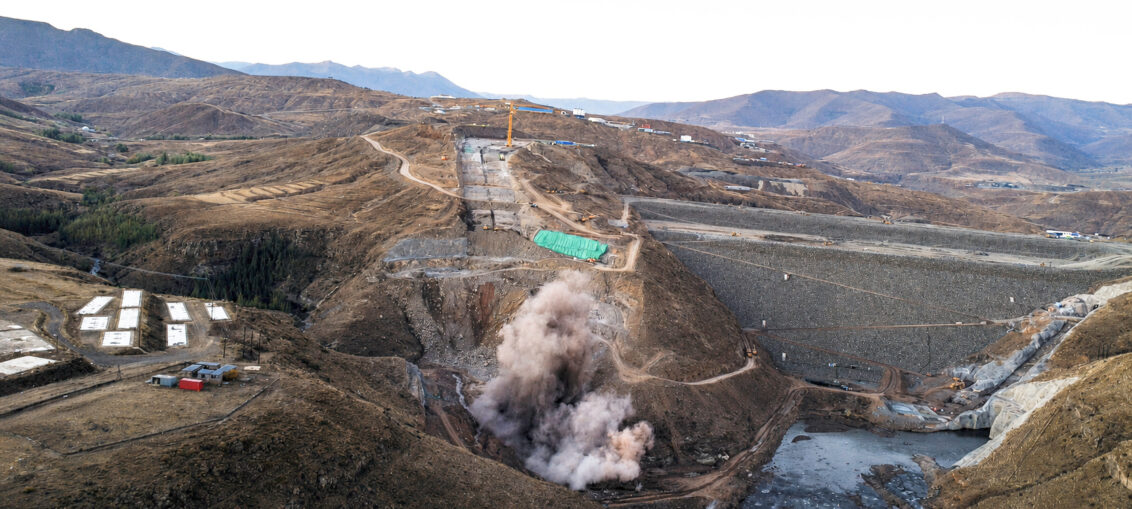
Dust from Polihali Dam construction and quarry sites regularly engulfs the nearby village of Tsekong. Photos: Sechaba Mokhethi.
“It looks like gathering rain clouds. The dust is very dark. You can see it coming from both quarry sites until it covers the whole of Tsekong”
Mamohlakola Letuka and Selloane Nyakane
The Lesotho Highlands Water Project (LHWP) promises water benefits for South Africa, far beyond the mountains where it is being built. But in a small Lesotho highlands village of Tsekong, in the district of Mokhotlong, close to the construction site, residents say they are paying a high price for that development. Regular blasting sends clouds of dust through the village, which residents say has coincided with persistent health problems, threatening livelihoods and making homes unstable.
There is a gap between residents’ accounts and the Lesotho Highlands Development Authority (LHDA), which manages the infrastructure project and argues that there is no evidence linking the construction work to village health problems. Government’s public health officials in Mokhotlong are in the dark. They don’t have the information needed to assess the extent of illness in the community. They also say LHDA withholds reports from its on-site clinics.
Lesotho’s Ombudsman has, however, investigated complaints about phase two of the project. In a report released in March, the Ombudsman found that Tsekong was particularly exposed to dust from the project because prevailing winds carried it towards the village. Following the investigation, the LHDA prioritised relocation of Tsekong households. Months later, however, families remain in the village while blasting continues.
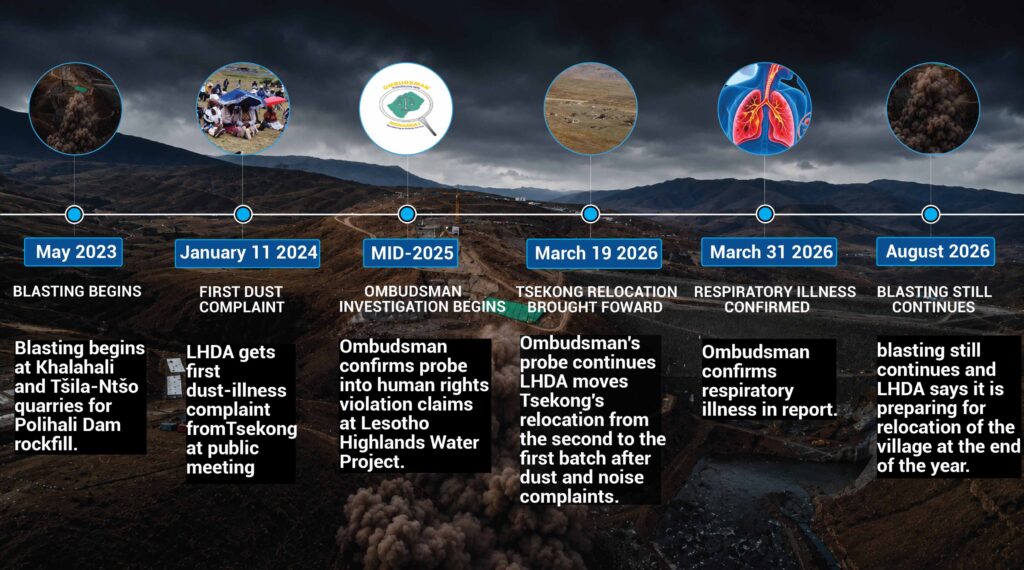
Timeline of events by Retšelisitsoe Khabo
The 47 households that make up Tsekong village are between 500m to one kilometre away from the Khalahali and Tšila-Ntšo quarry sites, which produce rockfill for the construction of the M52 billion Polihali Dam. This is the centrepiece of the second phase of the LHWP.
So far, 250 households from nine villages have been relocated in this project phase, according to the Ombudsman report.
Tsekong village relocation was brought forward following the Ombudsman’s March findings. The LHDA told MNN Centre for Investigative Journalism (MNN) that approximately 18 households of Tsekong “are currently residing elsewhere, independent of project activities, and have elected to receive cash compensation for their homestead assets”. According to LHDA, that compensation has not yet been disbursed, apart from one household.
Tsekong’s Chief ‘Matekano Motabola told MNN that some families have relocated at their own expense because they could no longer tolerate the dust. She intends to do the same.
“LHDA keeps promising relocation and calling meetings, but nothing changes,” she said adding that, although the dust affects almost every aspect of life in Tsekong, the impact on people’s health is significant with many, including children, having developed persistent coughs, eye irritation, headaches and skin rashes.
“Our houses are cracked and the dust enters the house. Whenever they blast we even take our dishes down,” said Chief Motabola.
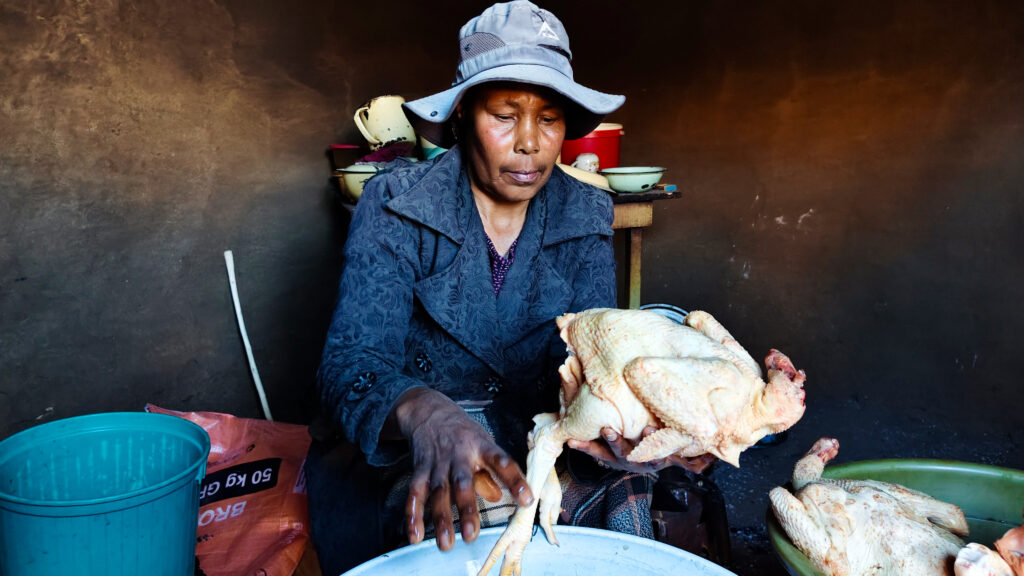
Tsekong village chief Matekano Motabola says residents have endured years of dust, noise, and vibrations from quarry blasting for the Polihali Dam. At the same time, many families continue to wait for relocation.
Village resident Morenakemang Khatleli told MNN that the dust is unlike ordinary windblown soil.
“It doesn’t look like a whirlwind. It looks like gathering rain clouds. The dust is very dark. You can see it coming from both quarry sites until it covers the whole of Tsekong,” said Khatleli who adds that the dust also smells foul. Many residents believe that it is poisonous.
“I suspect it is the reason for this cough. It feels like flu that never goes away. I feel like I have swallowed dust. I always cough,” explains Khatleli whose daughter wakes up with swollen eyes with white discharge after blasting. The LHDA clinic referred affected children to the nearby Mokhotlong Hospital.
Another parent, Maseithati Konki, who was residing at her family’s house in Tsekong decided to relocate to nearby Lilimala after her daughter developed persistent eye problems. Konki says the contractor on the Polihali project promised her treatment from an eye specialist, but that never happened.
“I have continued buying medicine from the pharmacy myself,” says Konki who worries the condition could affect her daughter’s education because she sometimes struggles to read.
Video shot by Billy Ntaote and Sechaba Mokhethi. Edited by Retšelisitsoe Khabo.
Who is monitoring the health impact?
A lack of independent health data complicates the dispute over the health effects of the dust.
Dr Mamohoanyane Chabana, the Mokhotlong District Medical Officer, told MNN that the state’s district health authorities do not receive reports from the LHDA project clinic about residents treated there, including children from communities around the construction site.
“The contractors do not give us any reports,” Chabana said. “We have no statistics; we only know that they came to the hospital.”
Chabana said the District Health Management Team had repeatedly struggled to obtain information from the project. Even when officials requested health reports, she said, they were not provided. “They even refuse when we go to their premises to request information,” she said.
The result, she said, is that the district health authorities responsible for monitoring public health in Mokhotlong do not have a picture of illnesses potentially associated with the project.
“As for the cause or conditions related to dust pollution and other environmental impacts, they do not inform us. They report to LHDA and not to the DHMT.”
The DHMT has also not conducted an independent assessment of the project’s health impacts. She said the Ministry of Health does not have a hygienist in the district to monitor communities exposed to dust from the construction and quarrying operations.
Instead, she said, companies operating in the area employ their own hygienists.
This leaves LHDA with information about people treated through its project health system that is not routinely available to the district’s public health authorities.
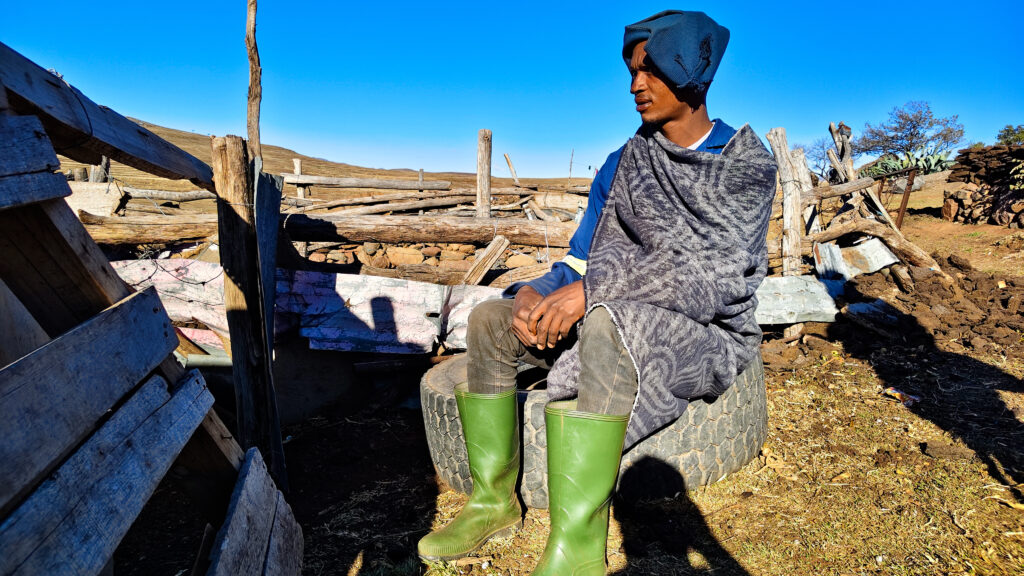
Morenakemang Khatleli, a resident of Tsekong, says dust from quarry blasting has left him with a persistent cough and caused recurring eye problems for his daughter.
More damage than dust
Residents say the impact extends beyond their health.
They told MNN that rocks thrown by blasting have landed in their fields, making cultivation difficult, while repeated vibrations have cracked homes throughout the village.
Motabola said dust settles on crops after almost every blast, while Khatleli said residents live in constant fear that their houses could collapse.
LHDA spokesperson Mpho Brown said LHDA investigates reports of rock fragments landing on agricultural fields and removes them where necessary. He said one recent case was resolved before the planting season began and the landowner confirmed satisfaction with the remedial work.
He added that assessments of the remaining agricultural fields are being finalised and compensation will be processed once verification has been completed.
For Khatleli and other villagers at Tsekong, however, relocation remains the only real solution. “There is no salvation here. We just want to leave.”
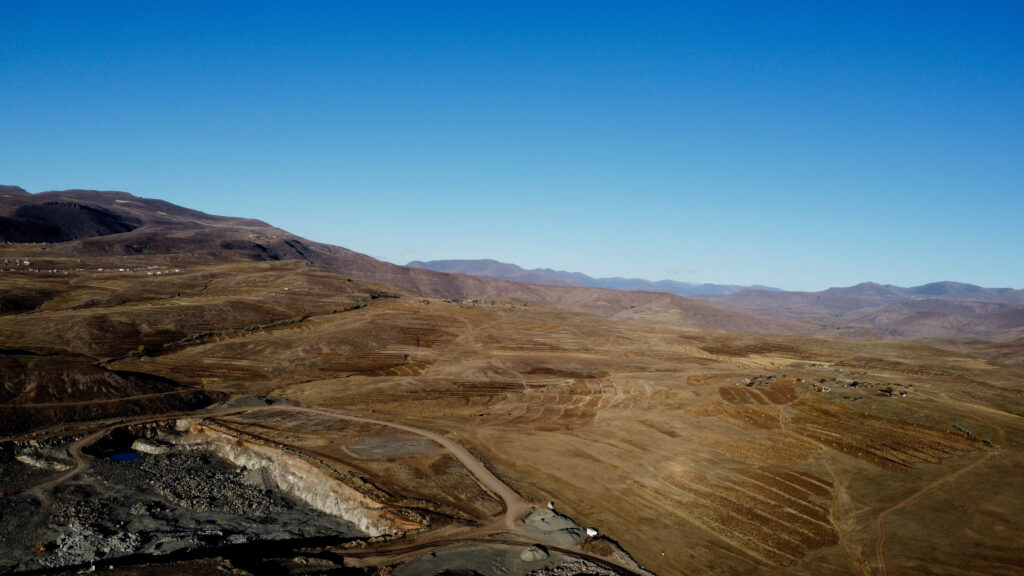
Tšila-Ntšo quarry site, one of rockfill sources for the Polihali Dam, lies just a short distance from Tsekong village (right), where residents say quarrying and blasting have exposed them to persistent dust pollution.
LHDA stands firm
Brown said the relocation of Tsekong remains a priority and that the authority takes health concerns seriously. He disputed any link between the construction work and illness in Tsekong, saying four children, two from Tsekong and two from Litsotsong, had received treatment through the project clinic before being referred to Mokhotlong Hospital, where doctors diagnosed allergies rather than illnesses linked to blasting.
According to Brown, the children later recovered following treatment and their parents confirmed in writing that they were satisfied with the medical care. While the LHDA has not shared these written confirmations, parents interviewed by MNN have disputed this account, saying their children’s symptoms continued after treatment and that they eventually sought additional medical care themselves.
Brown said that the process of securing replacement houses and associated infrastructure is expected to be completed by September 2026, with physical relocation scheduled to take place before the end of the year.
He said LHDA has “no formally registered complaints” linking recurring coughs or respiratory illnesses to blasting. “Nevertheless, environmental monitoring and community engagement continue as part of the project’s ongoing oversight measures,” he said.
Brown added that air quality, dust, noise and blast vibration have been monitored throughout construction and that no readings have exceeded project limits or prescribed environmental standards.
He also rejected claims that mitigation measures had been discontinued. Brown said respiratory masks continue to be distributed where appropriate and that temporary evacuations are still carried out during scheduled blasting. Some residents now choose not to leave during blasting, he said, because the operations remain within established safety controls.
Brown nevertheless acknowledged that construction dust had affected Tsekong. “While the village was originally identified for relocation due to future reservoir impoundment, the programme was subsequently prioritised and accelerated because prevailing wind conditions resulted in increased dust exposure from quarry operations,” he said.
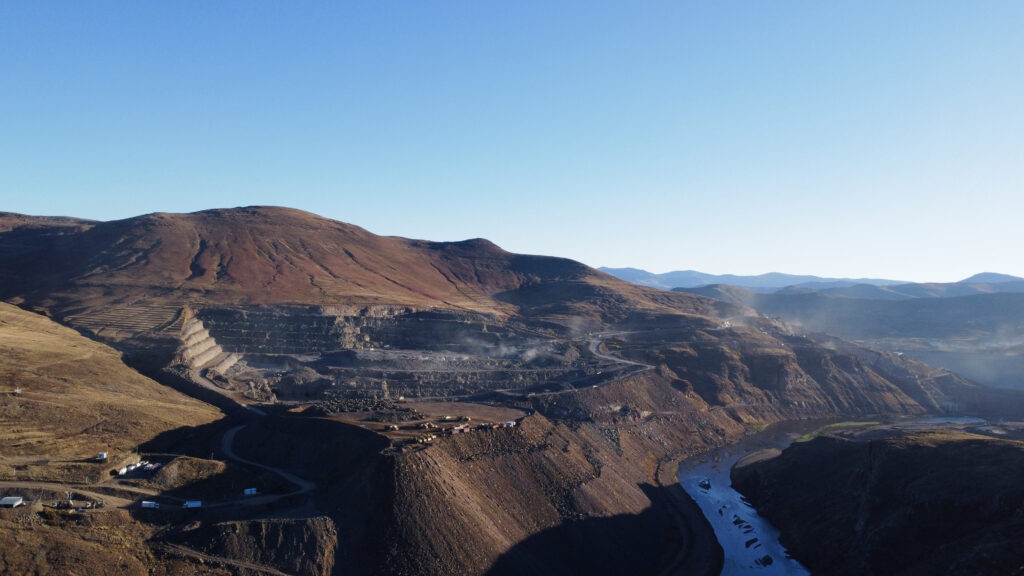
The Khalahali rockfill quarry, which supplies rockfill for the Polihali Dam wall, has transformed the landscape as nearby residents say blasting and quarrying have blanketed their villages in dust.
