
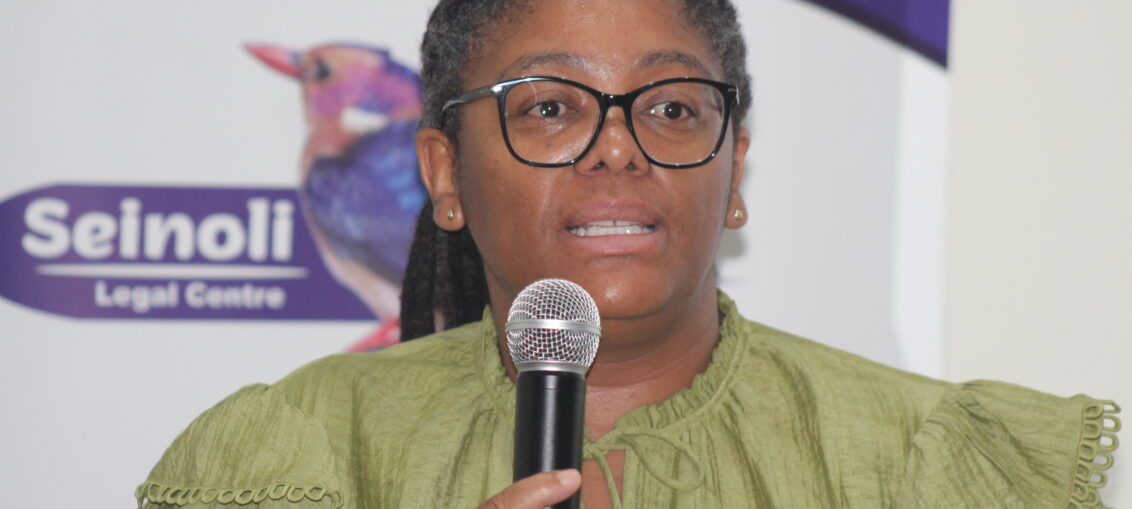
Seinoli Legal Centre’s executive director Advocate Reitumetse Nkoti-Mabula. Photo Rets’elisitsoe Khabo
Billy Ntaote
Residents of Masakong are still defecating in the open more than four months after an MNN Centre for Investigative Journalism investigation exposed their sanitation crisis and was followed by formal legal intervention against the Lesotho Highlands Development Authority (LHDA).
The investigation was followed by a letter of demand from Seinoli Legal Centre on behalf of Masakong residents, while LHDA acknowledged that some sanitation facilities had deteriorated and said it was assessing what further intervention was needed.
But when MNN returned to the community in August, residents said they still had no operational toilets and continued to rely on open defecation.
The reporting moved the issue from a community complaint to a formal legal demand and an official acknowledgement from LHDA, which has yet to produce a functioning toilets for the Masakong community.
What we triggered
MNN reported on April 16 that residents of Masakong, near the gates of the Polihali Village, had been forced to use exposed areas after temporary toilets provided by LHDA became full, while iron sheets had corroded and broken, rendering the facilities unusable.
The investigation found that 13 temporary shared pit latrines had been provided while residents awaited resettlement. The growing population around the Polihali construction area had worsened the problem.
Women and girls faced particular risks to their privacy, dignity and safety, while residents were also restricted from constructing new permanent structures because of the impending relocation.
On May 26, Seinoli Legal Centre’s executive director, Advocate Reitumetse Nkoti-Mabula, wrote to LHDA on behalf of the residents, describing the conditions as a violation of their fundamental rights.
Nkoti-Mabula said the situation “constitutes a serious violation of the affected residents’ fundamental rights, including the right to human dignity, the right to health, the right to a clean and safe environment, the right to adequate housing and sanitation, the right to equality and protection from gender-based discrimination and humiliation.”
She said LHDA was also violating rights protected under the Constitution of Lesotho and international human rights instruments to which Lesotho is a party, including the African Charter on Human and Peoples’ Rights and the Convention on the Elimination of All Forms of Discrimination Against Women.
She further argued that LHDA was violating its own environmental and social management policies and resettlement obligations under the Lesotho Highlands Water Project (LHWP) Phase II agreements signed by Lesotho and South Africa.
Concrete action demanded
Seinoli gave LHDA 14 days from receipt of the May 26 letter to take urgent measures.
The legal centre demanded additional temporary sanitation facilities, including mobile chemical toilets; the emptying, cleaning and maintenance of existing pit latrines; and permanent Ventilated Improved Pit (VIP) latrines or equivalent infrastructure for the affected community.
It also called for LHDA to withdraw its instruction preventing residents from constructing their own toilets, support households wishing to build temporary facilities, and develop a Sanitation and Dignity Restoration Plan in consultation with the affected community, particularly women and girls.
Seinoli further demanded written confirmation of the measures, including timelines and responsible officials, and warned that it would pursue urgent legal action if LHDA failed to comply.
LHDA acknowledges the problem
On June 9, LHDA chief executive Tente Tente acknowledged that some sanitation facilities may have deteriorated and that previous interventions may not have fully addressed the community’s current needs.
Tente said LHDA was assessing the condition and capacity of the facilities and that the assessment would determine further intervention. He said Seinoli’s proposals, including mobile chemical toilets and the cleaning and emptying of existing pit latrines, were being considered.
Regarding residents’ concerns that LHDA had prevented them from constructing new sanitation facilities, Tente said: “LHDA clarifies that guidance was intended to avoid construction of new permanent structures after the formal declaration of the Cut-off-Date for the village, which is designed to prevent compensation disputes or for structures to become redundant due to resettlement, in line with best practice … This was not intended to restrict access to sanitation. LHDA remains open to identifying practical interim solutions with affected communities.”
Tente said LHDA also acknowledged the importance of privacy, dignity and safety, particularly for women and girls.
He said the authority continued to engage with community leadership structures, affected households and stakeholders to address immediate and long-term sanitation needs. “Ongoing reviews are undertaken, and additional measures will be implemented where necessary, pending relocation and the rollout of long-term solutions.”
Seinoli seeks clear timelines
Seinoli said LHDA’s response did not address the urgency of the situation, leading to Nkoti-Mabula writing another letter on June 18, saying the response lacked specific timelines, implementation modalities and interim remedial measures.
She asked LHDA to provide a comprehensive written implementation plan within seven days or convene a meeting within 10 days to agree on an actionable, time-bound framework.
LHDA has not responded to those demands, according to Seinoli.
Seinoli had also demanded that permanent VIP latrines or equivalent sanitation infrastructure be completed within 90 days of its May 26 letter. That 90-day period expired on August 24 without evidence that the requested infrastructure had been completed.
The 90-day period was a demand made by Seinoli, rather than a deadline accepted by LHDA.
MNN then returned to Masakong to establish whether the interventions discussed in the correspondence had translated into improvements for residents.
Four months later, residents still have no toilets
Speaking to MNN on August 21 and August 25, residents said the operational toilets remain unavailable and they continue to rely on open defecation.
Masebonyle Lebula said the community still had no operational toilets. “We still don’t have toilets. I know one resident, so far, who has resorted to build own toilet despite the LHDA’s orders stopping new construction, as there will not be any compensation provided,” Lebula said.
Tholang Lengoasa, who has two homes with his two wives, one in Ha Tlhakola and another in Masakong, said the situation remained unchanged. “There has not been any change to our lack of toilets,” Lengoasa said. “Our women are forced to go to the open defecation areas, which are hard to reach and very risky as they are by the edge of the hill we live on.”
Lengoasa said residents were caught between the sanitation crisis and restrictions on new construction because of the planned relocation. “Our lack of toilets is sad as we cannot do anything to resolve it by ourselves, as any new construction will not be compensated when they are relocated to the under-construction resettlement areas,” he said.
“LHDA has barred us from building new structures, and we see how our women suffer when they must go to these open defecation places. It’s very sad and humiliating.”
He said the situation was particularly difficult for elderly residents. “For the elderly men and women who cannot even walk to these open defecation places, it’s a much worse problem as they cannot go to the edges of the hill to defecate.”
Mapuso Lengoasa, another Masakong resident, also said there had been no change. “This has stripped us of our dignity, but there is little we can do to help ourselves. We are relying on you as a journalist to help us,” she said.
She said uncertainty over the timing of resettlement had compounded the problem, leaving residents unsure how long they would have to live without adequate sanitation.
Timeline
16 April 2026: MNN exposes sanitation crisis
MNN reports that Masakong residents are being forced to defecate in the open after temporary sanitation facilities become full and unusable.
26 May 2026: Seinoli issues formal demand
Seinoli Legal Centre writes to LHDA on behalf of residents, demanding urgent sanitation measures, servicing of existing facilities and permanent sanitation infrastructure.
9 June 2026: LHDA acknowledges the problem
LHDA responds, acknowledging that some sanitation facilities may have deteriorated and saying further interventions are being assessed.
18 June 2026: Seinoli says response is insufficient
Seinoli tells LHDA that its response lacks specific timelines, implementation modalities and interim remedial measures and requests an actionable, time-bound framework.
24 August 2026: 90-day period demanded by Seinoli expires
The period within which Seinoli had demanded completion of permanent VIP latrines or equivalent sanitation infrastructure expires.
25 August 2026: MNN checks the impact
Residents tell MNN that operational toilets remain unavailable and they continue to rely on open defecation.
