
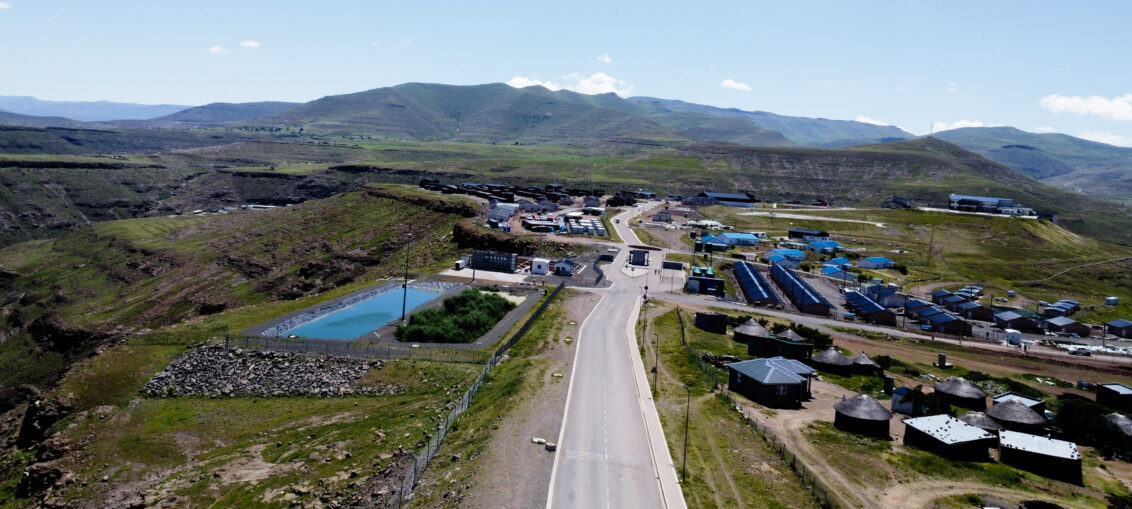
A view of the Polihali Village gates shows a blue pond on the left, and just outside the fence, an area below the road used by Masakong villagers for open defecation. Residents cross the tarred road daily from their village on the right to reach this site, entering through a gap in the fence that surrounds the area. Photo: Retšelisitsoe Khabo
Just metres from a multi-million maloti Polihali village built to host workers and visitors for one of Lesotho’s biggest infrastructure projects, villagers in Masakong say they have been forced back to open defecation, with no toilets left to use.
On one side stands the newly built Polihali village, a 454 million maloti legacy estate under phase 2 of the Lesotho Highlands Water Project, complete with more than 50 houses and a multi-storey lodge overlooking the future dam, currently under construction. On the other side, residents relieve themselves in the open, near the estate’s gates.
Residents say the Lesotho Highlands Development Authority (LHDA) took over land they had long used for open defecation and replaced it with 13 shared pit latrines. But those toilets are now full, broken, and unusable.
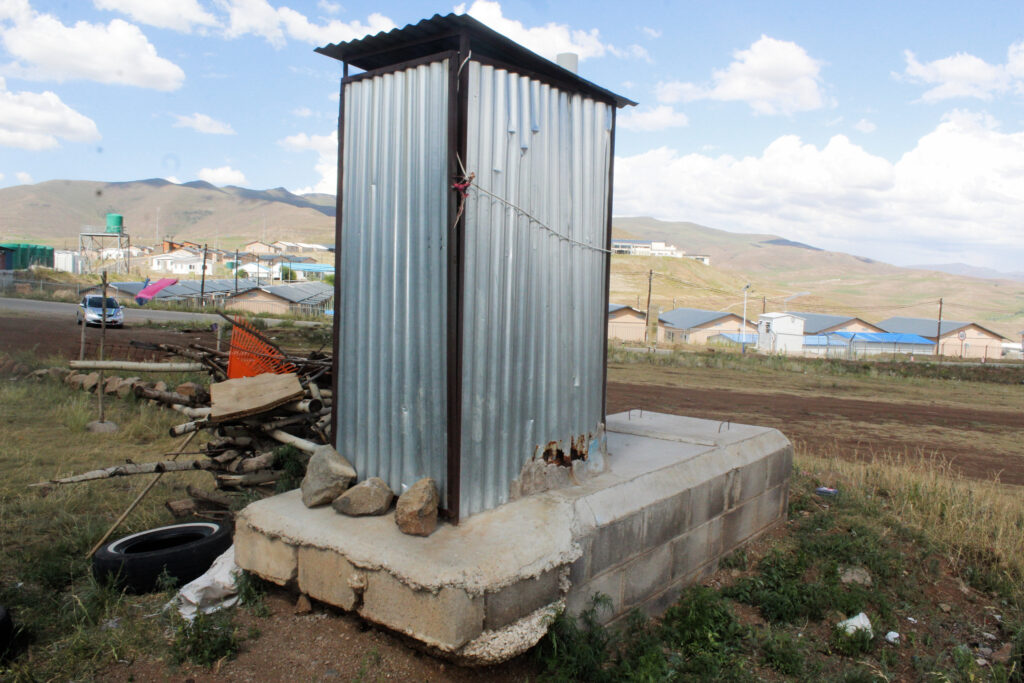
One of the temporary pit latrines built for the Masakong people. Photo: Billy Ntaote
MNN Centre for Investigative Journalism (MNN) visit to Masakong found several of the pit latrines filled to the brim and in some cases, waste reaching the toilet seat. Rusted corrugated iron sheets, some punctured with holes, expose a mix of faeces, toilet paper, and sanitary products hardened into solid waste and filling the pit latrines.
With no functioning alternatives, residents say they have no choice but to defecate in the open, and in many instances, in full view of passersby.
Too few toilets for too many people
Before construction of Polihali village, Masakong residents used designated open areas, separated by gender and relatively secluded. Those areas were later cordoned off by LHDA.
In their place, LHDA built temporary shared pit latrines. But according to local chief Phakisang Sekonyela, these were designed for a much smaller population.
“What started as a community of about 198 people has grown significantly due to the arrival of migrant workers,” he said.
MNN counted just 13 pit latrines serving three parts of Masakong: two in Ha Tlhakola, five near the Polihali village gates, and six near a route leading to the dam construction site.
The villagers, ‘Matšaba Lengoasa and Retšelisitsoe Raisi, say at least 1,024 people now live in two of the Masakong sections alone, excluding Ha Tlhakola, which has also grown due to migrant arrivals. This means, according to villagers, dozens of people shared a single toilet, leading to it quickly filling up.
International guidelines paint a stark picture. According to United Nations Water, Sanitation and Hygiene (WASH) and Sphere standards, a minimum of one toilet should serve no more than 50 people in emergency settings, and ideally, there should be one toilet for every 20 people.
By those standards, Masakong’s situation is one toilet to 78 people and it would need between 21 and 52 toilets. It has 13, most of them unusable.
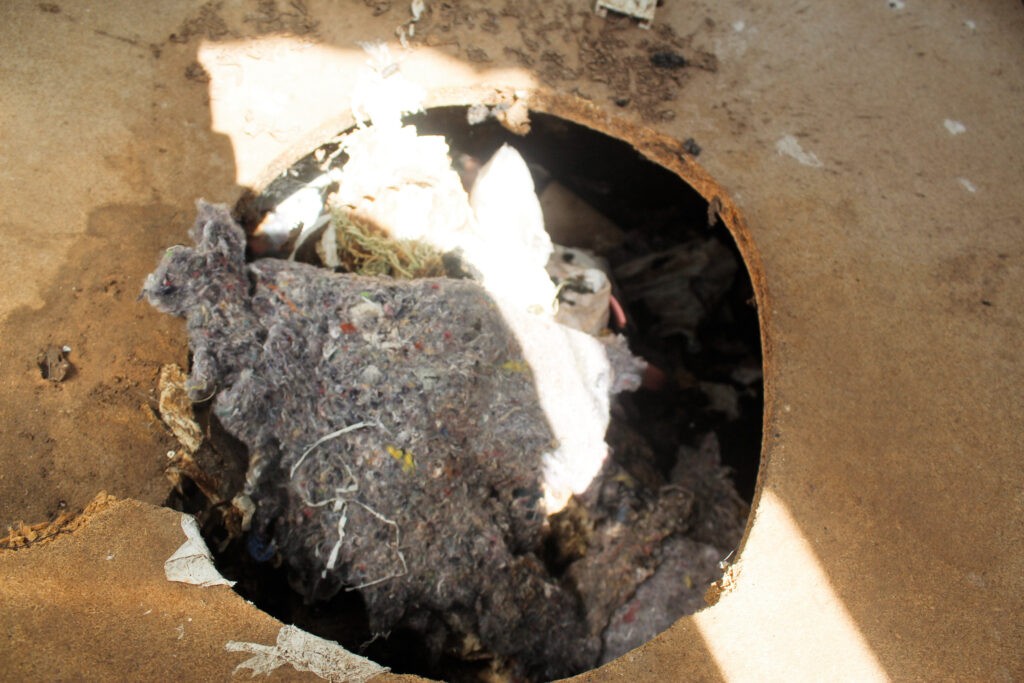
Inside one of the full temporary pit latrines. Photo: Billy Ntaote
“We have lost our dignity”
Ikhetheleng Raisi, a lady residing in Masakong, told MNN that sharing the overcrowded toilets was already difficult before they filled up, but being forced into open defecation has become even more humiliating for them as women.
“The toilets were not safe. Some could not lock from the inside,” she said. “During menstruation, it became even worse because of the number of users, as some would mess up the seat.”
Now that the toilets are full, she says women are forced into the open despite the presence of large numbers of male migrant workers in the area. “It is shameful. There are always men moving around, looking for work. But we have no other option.”
Two women in their mid-30s, who asked not to be named, guided MNN reporters to one of the open defecation sites near the Polihali village gates. “Our dignity has been taken away,” one said. “We have to undress outside, and people can see us.”
They described incidents where men unexpectedly passed by while they were relieving themselves. “Sometimes they come from behind us while we are undressed,” the other said. “We do not feel safe.”
Before LHDA arrived in Masakong, they said, the community managed without toilets because they had private, gender-separated defecation areas. “But now there are too many people. Toilets are necessary, but we don’t have them,” one said.
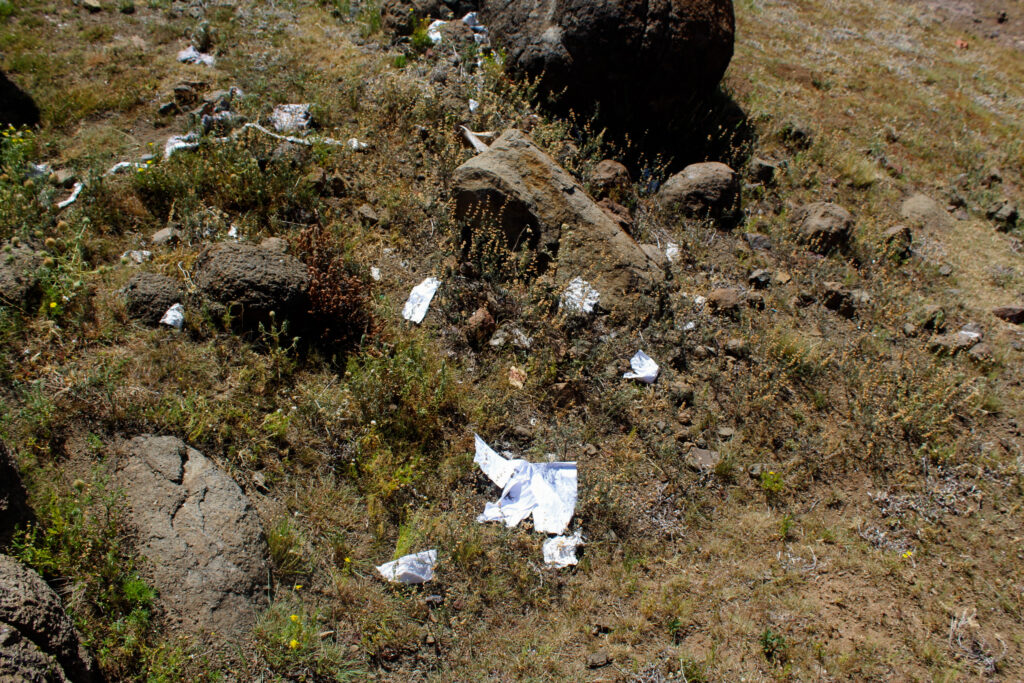
Toilet paper remains littered in the open defecation area, signalling places where people once squatted to take a dump. Photo: Billy Ntaote.
A problem worsened by the project itself
The sanitation crisis is closely tied to the LHWP project.
Polihali village was built to accommodate engineers and consultants working on the dam and transfer tunnel, part of a M53-billion project that includes a 38km tunnel linking Polihali to Katse Dam.
The development has drawn workers and job seekers into nearby villages like Masakong, dramatically increasing population pressure.
Residents say this influx is what filled the toilets so quickly. “Roughly 50 people were using each toilet every day,” said Retšelisitsoe Raisi. “They filled up very fast.”
He added that the loss of traditional defecation areas has left women and girls particularly vulnerable.
“Now they are pushed to rocky, exposed areas. There is no privacy. There is a real risk to their safety,” he said.
Other residents, including Maamohelang Lengoasa and Matsaba Lengoasa, described worsening hygiene conditions, with open areas littered with waste and toilet paper.
They also said they had previously been discouraged from building their own toilets.
“We were told new structures would not be compensated when relocation happens,” Matsaba said.
LHDA response
In response to MNN’s questions, LHDA spokesperson Mpho Brown said the authority is aware of the problem and has begun addressing it.
He said chemical granules had been procured to help break down waste in filled pit latrines and restore functionality. He also said contractor Kopano Ke Matla (KKM) had built three additional toilets.
Brown added that LHDA is planning longer-term sanitation improvements, including ventilated improved pit (VIP) latrines, and that each relocated household will receive a toilet under the resettlement programme.
But residents dispute these claims.
Ikhetheleng said no one in the community is aware of the chemical treatment mentioned by LHDA. “The only thing we remember was something given to us in 2025 that reduced the smell, but it did not solve the problem,” she said.
Villagers also say they have not seen any new toilets being built recently.
On the issue of residents building their own toilets, Brown said LHDA does not prohibit construction. However, he confirmed that structures built after a cut-off date, which is 7 December 2024 for Masakong, are not eligible for compensation. “This is standard practice to prevent speculative construction,” he said.
But for residents, this policy has had unintended consequences. Many say they avoided building toilets out of fear they would not be compensated when relocation happens, leaving them dependent on shared toilets that are now unusable.
For Masakong residents, the situation feels like a step backwards. “We are back to open defecation,” said Retšelisitsoe. “But now it is worse, because our spaces are gone and there are more people.”
As Lesotho’s flagship water project rises above them, promising development, tourism, and economic growth, the community living in its shadow is grappling with a basic unmet need: a safe place to go to the toilet.
Until that is addressed, residents say, the promise of development will remain out of reach.
