
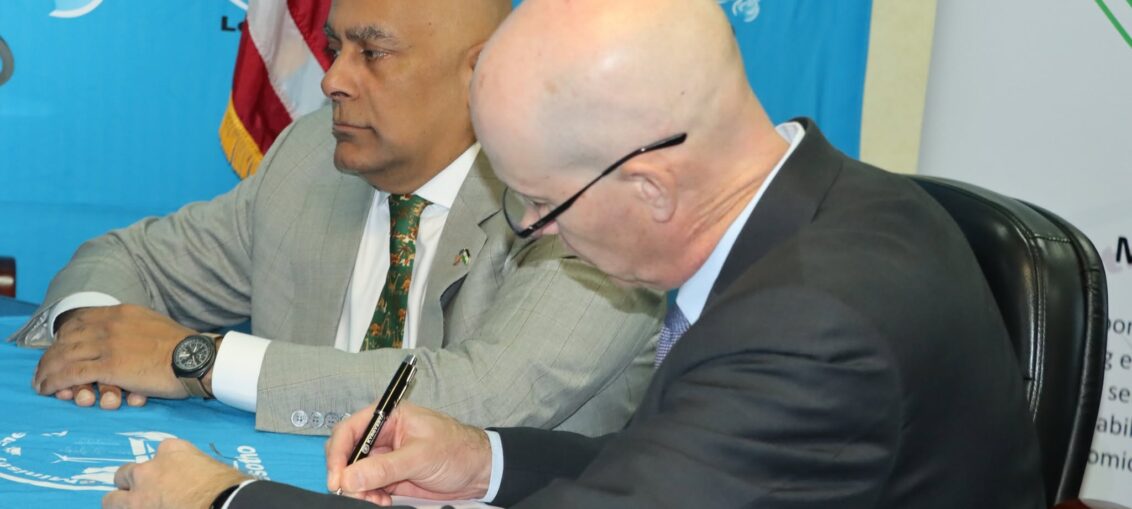
(Left) Hari Achuthan during the MOU signing in Maseru. Photo: US Embassy
Also read Part One: Questions over vetting process as Lesotho signs M98bn Kobong deal
Court records and public contracts from New York show that Convalt Energy’s previous flagship manufacturing project never materialised despite receiving public funding and government support.
For nearly five years (2021 to 2026), Convalt Energy promoted plans to build a major solar panel manufacturing complex near Watertown International Airport in northern New York. Local authorities backed the venture with public land, development rights, infrastructure support and a $1.05 million (about M17.4 million) loan.
But the factory was never built and the project ultimately ended in a loan default, a lawsuit against Convalt Energy and its founder, president and CEO Hari Achuthan, and a settlement requiring the company to repay public funds.
The failed solar manufacturing venture raises questions about Convalt’s track record as it pursues what would be the largest foreign direct investment in Lesotho’s history.
A flagship manufacturing project
On 15 September 2021, Convalt Energy signed a Land Development Agreement with the Jefferson County Industrial Development Agency (JCIDA), a public economic development body in New York State.
The agreement gave Convalt rights to develop approximately 88 acres of publicly owned land near Watertown International Airport. According to the agreement, the company proposed a phased development of an “up to 500,000 square foot manufacturing facility” for solar panel manufacturing and solar power generation.
The plans included manufacturing buildings, energy-generation facilities, parking areas, stormwater systems and utility improvements.
As the project advanced, JCIDA granted Convalt an exclusive option to acquire the land, together with access rights for engineering studies and project planning. By November 2022, the agency had amended the agreement to allow preliminary site preparation work, including clearing, grading and other construction-related activities before the project formally closed.
The project was being promoted as a major manufacturing investment that would help establish a domestic solar supply chain in the United States.
Public loan support
In July 2022, JCIDA provided Convalt with a US$1.05 million loan to help finance the project
A series of agreements signed on 12 July 2022, including a loan agreement and promissory note, required Convalt to repay the loan with interest at 3% per annum. The loan was due to mature on 12 May 2023, with monthly interest payments due before the principal became payable.
JCIDA did not rely solely on Convalt’s promise to repay. Under a security agreement, it obtained a first-priority security interest over Convalt’s assets, including equipment, inventory, accounts, intellectual property and future business assets.
JCIDA also required additional guarantees. Achuthan personally guaranteed the loan, while Convalt Manufacturing LLC and ACO Investment Group LLC signed unconditional guarantees undertaking to repay the debt if Convalt Energy failed to do so.
The extensive security arrangements suggest that JCIDA considered the loan significant enough to require both personal and corporate guarantees.
The factory that never came
Despite the agreements, land access and public financing, the manufacturing facility never materialised. The project had originally envisaged construction of an approximately 300,000-square-foot factory on the Hounsfield site.
Years later, it remained unbuilt.
According to a June 2026 report by the Watertown Daily Times, Convalt Energy ultimately defaulted on the JCIDA loan “after failing to build the 300,000-square-foot plant on the Route 12F site in the town of Hounsfield.”
Instead of overseeing a completed manufacturing complex, local authorities found themselves pursuing repayment of public funds.
MNN asked Achuthan why the loan had not been repaid earlier and what led to the default.
He did not directly answer those questions, saying only that: “the project did not advance as planned due to state and county incentive commitments that were ultimately not delivered…circumstances outside Convalt’s control”.
The dispute soon escalated into formal legal action.
Default notice
The breakdown of the relationship became public in October 2024.
On 3 October 2024, Justin S. Miller, an attorney acting for JCIDA, sent Achuthan a formal “Notice of Default, Expiration and Demand.”
The agency informed Achuthan that Convalt had failed to make required payments for August, September and October 2024, totalling $7,875. “Please also accept this letter as a notice of default and demand,” JCIDA’s attorneys wrote.
JCIDA warned that late charges would be imposed and that, unless the arrears and outstanding balances were paid, the loan would accelerate at a default interest rate of 10% until paid in full.
The agency also notified Convalt that its rights under the land development agreement would expire on 1 November 2024.
Lawsuit follows
Four months later, on 10 February 2025, JCIDA filed suit in New York Supreme Court against Convalt Energy, Convalt Manufacturing LLC, ACO Investment Group LLC and Hari Achuthan.
The complaint alleged that the defendants had failed to repay the public loan and sought recovery of outstanding amounts due under the various loan documents.
The lawsuit brought together the web of agreements executed in July 2022, including the promissory note, security agreement, guaranties and financing statements.
Convalt did not simply concede the claims.
In the defendants’ May 2025 answer and counterclaims, the company and its co-defendants denied many of JCIDA’s allegations and disputed aspects of the agency’s claims.
Their attorneys repeatedly stated that documents referenced in the complaint “speak for themselves” and denied wrongdoing that could be inferred from the allegations.
The court filings show that the dispute remained active throughout much of 2025 and into 2026.
Despite the red flags, Achuthan has assured MNN that “this matter has no bearing whatsoever on our ability to finance or execute Project Kobong”.
Settlement negotiations
By March 2026, both parties were already informing the court that settlement discussions were underway.
In a settlement status letter to Justice William Ramseier dated 17 March 2026, Convalt’s attorneys wrote that the parties had been “negotiating a settlement in good faith” and were reviewing a proposed settlement agreement.
A month later, on 15 April 2026, both sides told the court they were “close to resolving this matter” and requested additional time to finalise the deal.
The dispute ultimately resulted in a repayment arrangement.
According to the Watertown Daily Times, Convalt and JCIDA agreed a settlement package under which the company would repay the defaulted $1.05 million loan. The paper reported that JCIDA received an initial payment of $125,000, with a second instalment due in November this year.
Responding to MNN, Achuthan said: “We reached an amicable settlement with JCIDA, have made our initial payment, and are fulfilling our remaining obligations on schedule.”
Despite reports that the project never happened and the site remains “shovel-ready with a large pad to build on and sewer and water already available”, Achuthan said Convalt invested more than $5.5 million of its own capital into that site. MNN could not independently verify this claim.
Case discontinued
On 8 June 2026, the parties formally ended the litigation, four days after signing an agreement with Lesotho.
A stipulation of discontinuance filed in Jefferson County Supreme Court states that the lawsuit was discontinued with prejudice and without costs to either party.
The filing indicates that the dispute was resolved, although the settlement terms themselves were not included in the court documents reviewed by MNN Centre for Investigative Journalism.
Importantly, the discontinuance does not change the central facts documented by the case.
Convalt received public support, development rights and a $1.05 million publicly backed loan to help advance a major solar manufacturing project. The planned factory was never built, the loan went into default, and local authorities ultimately sued to recover the money before reaching a settlement.
