
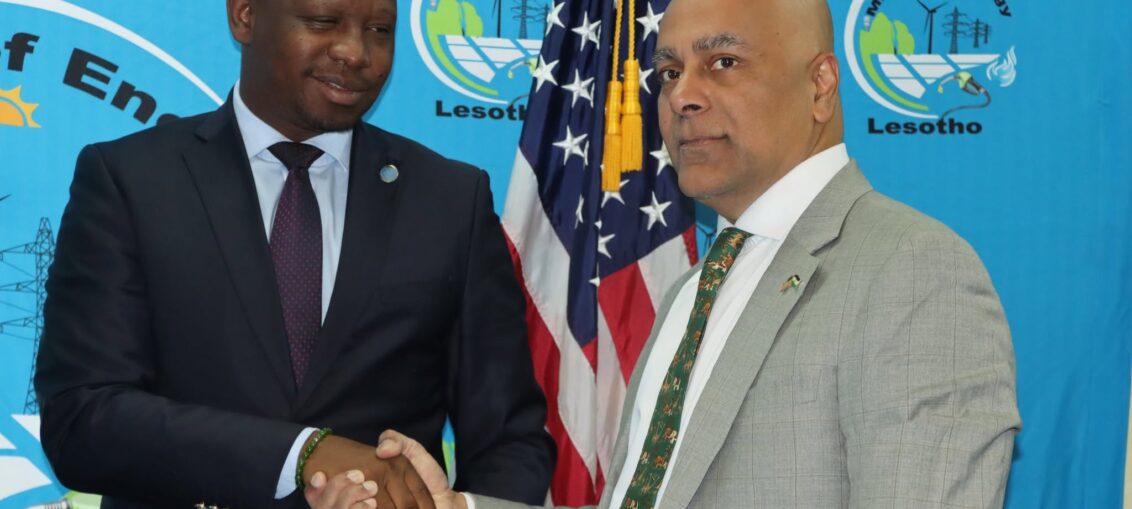
Hari Achuthan, Convalt Energy’s founder, president and CEO, seals the M98 billion hydropower deal with Lesotho Minister of Energy, Lejone Mpotjoane.Photo: US Embassy
The company selected to develop what could become Lesotho’s largest-ever foreign direct investment has a track record that raises important questions about the government’s due diligence before signing a binding agreement with New York Convalt Energy.
The company denies wrongdoing, while the Lesotho government assures Basotho that proper checks were done before signing the deal.
The M98 billion (US$6.2 billion) project, known as Project Kobong, promises 1,200 megawatts of hydropower generation and an integrated AI data centre that would position Lesotho as a regional energy exporter.
But has Convalt Energy, the company selected for the project, ever delivered a project like this?
MNN put questions to both Convalt and the Lesotho government about the company’s track record, previous litigation and the safeguards protecting Lesotho should the project fail. Both rejected suggestions that the agreement exposes the country to undue risk.
Convalt founder and chief executive Hari Achuthan told MNN that the company’s management team had structured and executed transactions worth more than US$30 billion during their careers. He also said Convalt had “developed landmark renewable energy projects, including one of the largest solar projects in Southeast Asia.”
When MNN asked whether he was referring to the Mandalay Solar Project, which is listed on Convalt’s website as a US$250 million investment in Southeast Asia, Achuthan did not respond. But his advisor, Victoria Harmon of VL Harmon Advisors, later confirmed that Achuthan referred to Mandalay.
MNN reviewed the ten power-generation projects listed on Convalt’s website. Eight, including Kobong, are described as “under development”, one as “operating” and one as “sold”.
Convalt’s legal history court documents filed in New York reveal that Convalt and its founder, president and CEO, Hari Achuthan, were previously named in a civil lawsuit alleging their involvement in a scheme involving stolen bitcoin miners and millions of dollars in cryptocurrency proceeds between 2020 and 2022. The allegations were never tested in court. In January 2023, New York Supreme Court Judge Richard Mott dismissed the claims against Achuthan and his two companies, Convalt and ACO Investment Group, after finding that the plaintiffs had failed to serve the court papers properly. As a result, the court never considered the evidence or ruled on whether the allegations were true.
Under Achuthan’s leadership, Convalt Energy also defaulted on a $1.05 million (M17.4 million) loan it took to finance a solar panel manufacturing plant near Watertown International Airport in northern New York. This plant was never built.
See Part Two: The flagship factory that was never built: Convalt’s M17m US loan ends in settlement
The lender sued. The case ended in a settlement under which Convalt agreed to pay US$125,000, with a second payment due in November this year. Court papers filed by Convalt do not dispute that it defaulted on the loan.
The litigation
The lawsuit was filed in 2022 by MinedMap Inc. and Serenity Alpha LLC, two bitcoin mining companies in Nevada.
The two companies alleged that Michael Maranda, a New York businessman, and several associates fraudulently obtained 2,380 bitcoin miners, misappropriated a $462,000 (M7.6 million) deposit intended for electricity costs, and mined more than $12.4 million (M205 million) worth of bitcoin.
The complaint alleged that Achuthan had a broader business relationship with Maranda than simply providing services. It claimed that the two men jointly owned or established several companies connected to the dispute, including Northway Mining, RPNY Holdings and Rouses Point Data Centre.
While denying that Achuthan or his companies were involved in any fraud, court paper filed by Conway Attorneys did not dispute that Achuthan had business dealings with Maranda. Conway argued that there is no evidence that Achuthan or his companies knowingly received stolen bitcoin or participated in a conspiracy. He said many of the allegations were disputed and should not be accepted as fact.
He argued that the plaintiffs had “frivolously named additional defendants” simply because they had “done business with Northway or Maranda in any capacity within the last few years”.
Those allegations are significant considering that the company has signed a binding memorandum of agreement with Lesotho’s Ministry of Energy for Project Kobong.
Achuthan told MNN that Lesotho faced little financial risk because Project Kobong would be privately financed without government guarantees.
“Convalt is assuming the project risk,” he said, adding that financing arrangements were being formalised and would be disclosed once the feasibility study had been completed.
How the alleged scheme worked
The MinedMap and Serenity Alpha complaint repeatedly refers to data-centre entities that the plaintiffs alleged were used to host and conceal their bitcoin miners.
The complaint also cites evidence from a Coinmint supervisor who allegedly told a witness that Maranda’s bitcoin miners were being hosted under a variety of company names, including Hudson Data Center and Oswego Data.
These entities were, according to the complaint, allegedly used to disguise the true ownership of those bitcoin miners.
In their court filing, MinedMap and Serenity Alpha alleged that Michael Maranda formed companies with no legitimate business purpose to conceal bitcoin miners they claimed had been fraudulently taken from them and other third parties.
The allegations against Achuthan
They also alleged that Maranda transferred miners obtained from them to Achuthan and his companies, and that, between 2021 and the filing of the lawsuit, he transferred more than US$100,000 to Achuthan, ACO Investment Group and Convalt. MinedMap and Serenity Alpha further alleged that Achuthan knew, or should have known, that Maranda’s businesses were not legitimate.
Summarising the plaintiffs’ case, Justice Richard Mott wrote that they alleged the Achuthan defendants had “received and profited from Plaintiffs’ bitcoin which they knew had been fraudulently obtained by Settling Defendants under the guise of a bitcoin mining contract.”
Justice Mott did not rule on the allegations. Instead, in January 2023, he dismissed the claims because the plaintiffs failed to serve the court papers within the required time.
As a result, the court never considered the evidence or decided whether the allegations were true.
Responding to MNN’s questions, Achuthan said: “The claims against Convalt Energy and its affiliates were dismissed by the court, which correctly determined that our role was limited to that of a vendor and electrical service provider.”
However, the judgment itself does not make that finding. It dismissed the claims on procedural grounds. It did not determine whether the allegations were true or false.
A $3.8 million settlement, but not for Achuthan
In September 2022, MinedMap and Serenity Alpha settled their claims against Michael Maranda and several companies linked to him, including Northway Mining, Hudson Data Center, RPNY Holdings, Rouses Point Data Center and Oswego Data.
The settlement says the agreement was reached to avoid the cost and uncertainty of litigation and “shall not be deemed an admission of wrongdoing.”
The agreement specifically excluded Achuthan, ACO Investment Group and Convalt Energy, allowing the lawsuit to continue against them. However, months later, Judge Richard Mott dismissed the claims against those three defendants on procedural grounds.
Was Convalt Energy vetted properly for Lesotho project?
Principal Secretary Tankiso Phapano said government first engaged with Achuthan in Morocco last year before he submitted a proposal. This was scrutinised before Lesotho sent Convalt a letter of intent and later signed an agreement allowing the company to do feasibility studies.
Minister of Energy, Lejone Mpotjoane, told MNN that assessments of the proposed project extended beyond reviewing the written proposal.
According to the minister, Achuthan told government he had experience operating energy projects in Asia and was establishing solar panel manufacturing and a data centre in New Mexico. The minister said Lesotho’s Chargé d’Affaires in Washington visited the New Mexico site to verify those claims.
Government was aware of the previous litigation against Convalt.
“Yes, we noted that Convalt was involved in some litigations in the USA. This is not abnormal in businesses, and we asked him. He explained what transpired and that the issue is now closed,” said Mpotjoane who stressed that Lesotho was not putting any money into the Kobong project, which limits Lesotho’s financial exposure.
Convalt, he added, has also been given milestones to meet and the memorandum of agreement would become “null and void” if those were not achieved. The minister added that construction would not begin before feasibility studies had been concluded and implementation agreements, including water-use plans, had been concluded.
Meanwhile, the United States Embassy spokesperson, Jessica Tosoriero, also confirmed that the embassy helped Convalt secure introductions to the Lesotho government.
Following MNN’s meeting with the embassy, it posted on Facebook that Convalt had completed pre-feasibility studies, was accelerating work on the final feasibility study and was assembling a consortium of banks to finance the project.
It added: “Unlike others, U.S. companies build on solid foundations with proper research and planning. This is how U.S. companies deliver what they promise, and benefit the people and places where they operate.”
MNN has since learned that the embassy only aimed to promote US business overseas. Due diligence was not their role.
